


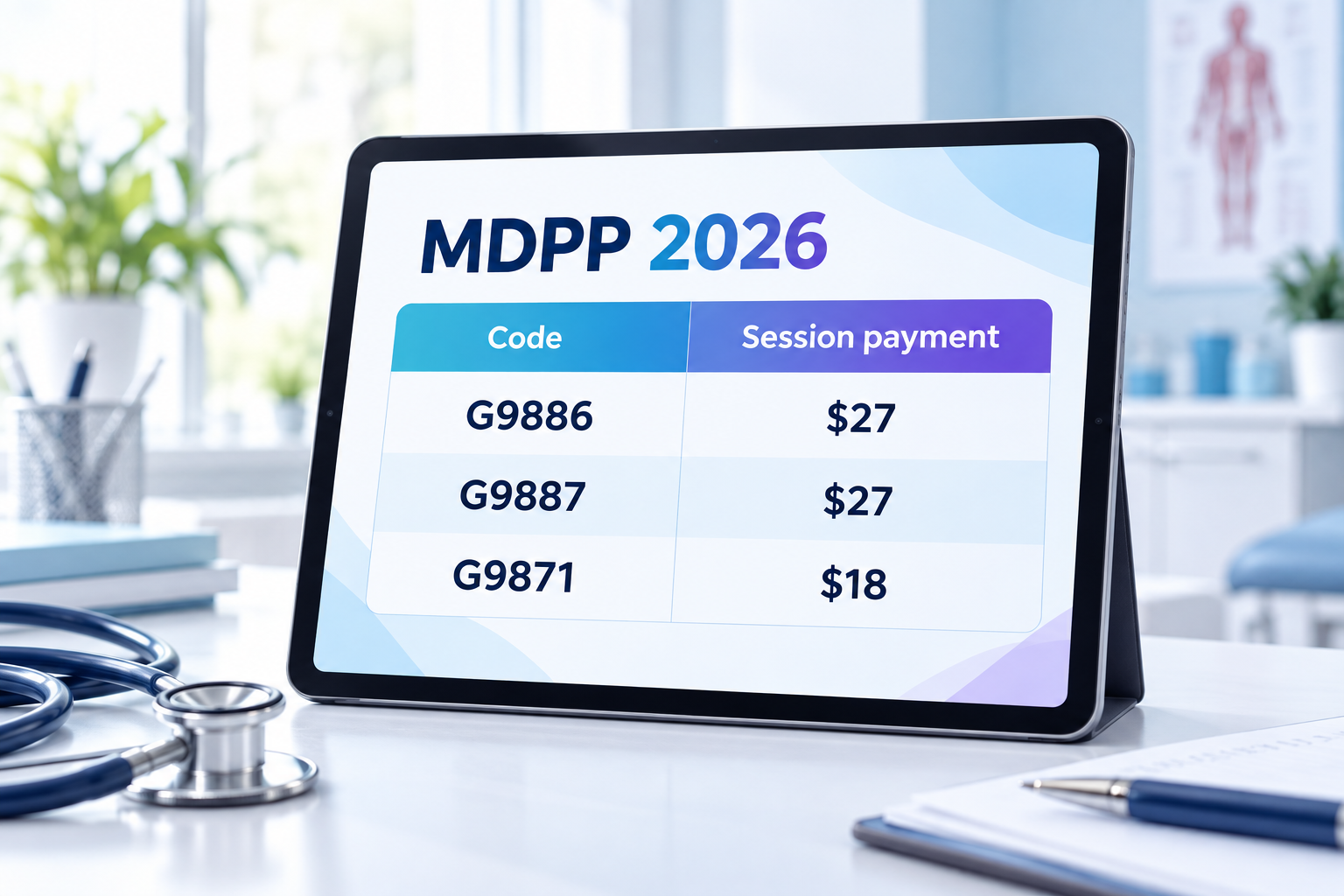
Medicare pays MDPP suppliers per session attended and per weight-loss milestone reached, using six HCPCS G-codes. In 2026 an in-person or distance-learning session pays $27, an online session pays $18, and reaching 5% weight loss pays $153. Billing correctly depends on capturing attendance, weight and delivery modality at the session level — the same data CDC requires for recognition.
What are the MDPP billing codes and payment amounts in 2026?
Six codes carry the entire program. Three pay for attendance, three pay for outcomes. Amounts below are from CMS’s CY2026 MDPP code and payment file.
| Code | What it covers | Condition | CY2026 payment |
|---|---|---|---|
| G9886 | In-person group session, 60 min | Attendance; max 22 combined with G9887 per year | $27 |
| G9887 | Distance learning group session, 60 min | Attendance; max 22 combined with G9886 per year | $27 |
| G9871 | Online (asynchronous) group session, 60 min | Attendance; cannot combine with G9886 or G9887 | $18 |
| G9880 | 5% weight loss from baseline | Achieved once | $153 |
| G9881 | 9% weight loss from baseline | Achieved once | $27 |
| G9888 | Maintained 5% loss, months 7–12 | With an attendance code, up to 6 times | $8 |
Two sequencing rules matter more than they look. G9880 and G9888 cannot share a date of service, and G9880 has to be billed before G9888. A system that lets a coach record a maintenance milestone before the initial 5% milestone has been claimed will generate a denial that nobody notices until the month closes.
The single largest payment in the program is the $153 for 5% weight loss. It depends entirely on having a defensible baseline weight and a defensible later weight. That is a data-capture problem, not a billing problem.
What changed for MDPP in 2026?
CMS finalized four changes in the CY2026 Physician Fee Schedule, and one of them reopens the program to organizations that were previously locked out.
Online delivery is now billable. A new asynchronous modality pays $18 per session under G9871, being tested through 31 December 2029. Participants work through the CDC-approved curriculum at their own pace with coach interaction.
Virtual-only suppliers can enroll. Through 31 December 2029, suppliers are no longer required to maintain in-person delivery capability. An organization with no classroom can now become an MDPP supplier.
Distance learning is extended through 2029. The synchronous-virtual flexibility that began as a public health emergency measure now has a fixed horizon well beyond it.
Weight capture loosened. Beneficiaries may self-report weight from home or another reasonable location outside an in-person site, and suppliers may accept a weight from a medical record dated within five days of the session.
That last change is the one most likely to break a system built before 2026. Weight now arrives from three different places — measured at a session, self-reported remotely, or pulled from a chart entry up to five days old — and the record has to know which, because the source affects what you can defend in an audit.
The modality rule that is really a data-model problem
A beneficiary receiving online MDPP cannot also attend in-person or distance-learning sessions. In-person and distance learning may be combined with each other freely; online is exclusive.
CMS’s reason is evaluation integrity — the model is testing whether asynchronous delivery produces comparable outcomes, which only works if the cohorts stay clean. The operational consequence is that modality is not a property of a session. It is a property of the participant’s enrollment, set once, and every session documented afterward has to be checked against it.
A system that treats modality as a dropdown on the session form will let a coach pick the wrong one. A system that locks it at enrollment and refuses the mismatch prevents a claim you would otherwise have to reverse.
How National DPP, MDPP and Medicaid NDPP differ
These three names get used interchangeably and they are not the same thing. Mixing them up is why organizations build for one and discover they cannot bill the other.
| National DPP (CDC) | MDPP (Medicare) | Medicaid NDPP (state) | |
|---|---|---|---|
| Who runs it | CDC, via DPRP recognition | CMS, as an expanded model | Individual state Medicaid agencies |
| What you get | Recognition, not payment | Fee-for-service payment | Payment, rules set by the state |
| Prerequisite | Apply to DPRP | DPRP recognition + Medicare enrollment | Varies; often DPRP recognition |
| Codes | None — recognition only | G9886, G9887, G9871, G9880, G9881, G9888 | State-specific |
| Data destination | CDC DPRP portal | Medicare Administrative Contractor | State Medicaid / MCO |
CDC recognition is the foundation under all of it. It pays nothing by itself, and both Medicare and most state programs require it before they will pay anything.
What it takes to become an MDPP supplier
Four things, in order, and the sequence is not optional:
- CDC DPRP recognition. Preliminary recognition requires at least 12 months of operation. This is the long pole.
- At least one active CDC DPRP organizational code, maintained.
- Medicare supplier enrollment, with an administrative location open during normal business hours and mandatory assignment accepted.
- Coaches enrolled in PECOS with NPIs, added within 30 days of furnishing services, with correctly dated association start dates.
CMS’s MDPP supplier FAQ covers the enrollment mechanics in detail.
That fourth item is where new suppliers get hurt. A coach who delivers sessions before being added to the organizational PECOS record creates claims with a rendering NPI Medicare will not recognize. The fix is a roster the billing process actually checks, not a spreadsheet the compliance officer updates monthly.
CMS also deactivates suppliers after 12 months without claim submission, and requires quarterly crosswalk files linking your participant identifiers to Medicare identifiers for model evaluation.
What CDC DPRP requires you to capture
Recognition depends on data you submit every six months to the CDC DPRP data portal, and the elements CDC requires are session-level:
- Weight at each session
- Physical activity minutes at each session
- Attendance, against a delivery floor of at least 16 sessions in the first six months and at least 6 in the remaining six
This is the same data the billing codes depend on, arriving on the same schedule, from the same coach, about the same person. Programs that keep recognition data in one place and billing data in another are maintaining two versions of one dataset and reconciling them by hand.
Four places programs lose money
Each of these is a capture failure, not a billing failure.
No defensible baseline weight. The $153 milestone is calculated against baseline. If baseline was recorded loosely — wrong date, wrong source, entered later from memory — the largest payment in the program is the one you cannot defend.
Attendance recorded as a headcount. A count of people in the room does not produce a claim. Each claim needs a named beneficiary, an MBI, a date of service, a modality and a rendering coach NPI. Reconstructing that from a sign-in sheet weeks later is how sessions go unbilled.
Milestones claimed out of order. G9880 before G9888, never the same date. Chronology enforced by the system rather than remembered by a biller.
Sessions delivered outside the roster. A coach not yet in PECOS, or added with the wrong association date, invalidates the rendering NPI.
What a system built for this actually needs
Stated plainly, because the requirements above reduce to a short list:
- Cohort and participant enrollment with modality locked at the participant level
- Session documentation capturing attendance, weight with its source and date, and physical activity minutes — per participant, per session
- A coach roster tied to NPIs and PECOS association dates, checked at claim generation
- Claim assembly that emits demo code 82, both NPIs, the MBI, POS and an ICD-10 code, with milestone sequencing enforced
- Two export paths from one dataset: DPRP submission every six months, claims continuously
- An audit trail on weight and attendance, because those are the two fields a payer will question
- Ten-year retention of demographics, eligibility evidence, session details, weights, curriculum topics and milestones — the record has to outlive the cohort by a decade
Medi-EHR is an ONC-Certified, cloud-based EHR platform built on AWS for behavioral health practices and managed care organizations. We have built NDPP enrollment and coach session-documentation forms, DSMES enrollment and ongoing-management dashboards, and CDSMP program forms on it, and we maintain an interface to a regional health information organization covering CDC community programs. The list above is not theoretical for us.
Key takeaways
- Six HCPCS codes carry MDPP: G9886 and G9887 pay $27 per session, G9871 pays $18, G9880 pays $153 at 5% weight loss, G9881 pays $27 at 9%, and G9888 pays $8 per maintained month.
- A beneficiary on online delivery cannot attend in-person or distance-learning sessions, so modality belongs to the enrollment record, not the session form.
- Suppliers are not required to maintain in-person capability through 31 December 2029, which makes virtual-only MDPP suppliers viable for the first time.
- CDC DPRP requires weight and physical-activity minutes at every session, submitted every six months.
- Recognition data and billing data are the same dataset; keeping them in separate systems creates reconciliation work and lost claims.
- Coaches must be in organizational PECOS within 30 days of furnishing services or their sessions cannot be billed.
- MDPP records must be retained for 10 years, including weights, session details and curriculum topics covered.
Frequently asked questions
Can a community-based organization bill MDPP directly?
Yes, if it enrolls as a Medicare MDPP supplier in its own right and holds CDC DPRP recognition. This is different from Community Health Integration services (G0019, G0022), which a CBO cannot bill directly and which require a physician or other practitioner to bill on its behalf.
How much can one MDPP participant generate?
Attendance across 22 sessions at $27 comes to $594, plus $153 at 5% weight loss, $27 at 9%, and up to six maintenance payments at $8. Actual totals depend on attendance and outcomes, and online delivery pays $18 rather than $27 per session.
Do we need CDC recognition before enrolling with Medicare?
Yes. DPRP recognition, with at least one active organizational code, is a prerequisite for MDPP supplier enrollment. Preliminary recognition requires 12 months of operation, so plan the calendar backward from when you want to bill.
Can we run the program on spreadsheets?
For a single cohort with one coach, plausibly. It stops working when you have concurrent cohorts, more than one coach, mixed modalities, or a payer asking you to substantiate a baseline weight from eight months ago.
What ICD-10 code goes on an MDPP claim?
No specific diagnosis code is required. Noridian’s MDPP guidance states that suppliers should use the most appropriate ICD-10 diagnosis for the beneficiary that captures the nature of the encounter. CMS documentation gives Z71.89 as one example, but it is an example rather than a mandate.
How long do we have to keep MDPP records?
Ten years. Suppliers must retain beneficiary demographics, evidence of eligibility, session details, weight measurements, curriculum topics covered, and milestone achievements for 10 years. That retention window, not the billing cycle, is what should determine where this data lives.
Does the online modality pay less because it is worth less?
CMS set G9871 at $18 against $27 for the other two. The modality is being tested through 2029 specifically to assess whether outcomes are comparable.
Talk to us about program infrastructure
If you run National DPP, DSMES or CDSMP and are reconciling recognition data against billing data by hand, that is a solvable problem. Request a demo and we will walk through how the session, cohort and claim records connect.
Reviewed against CMS and CDC source documents, September 2026. MDPP payment amounts and code definitions change with each Physician Fee Schedule — verify against CMS before relying on them for a billing decision.