

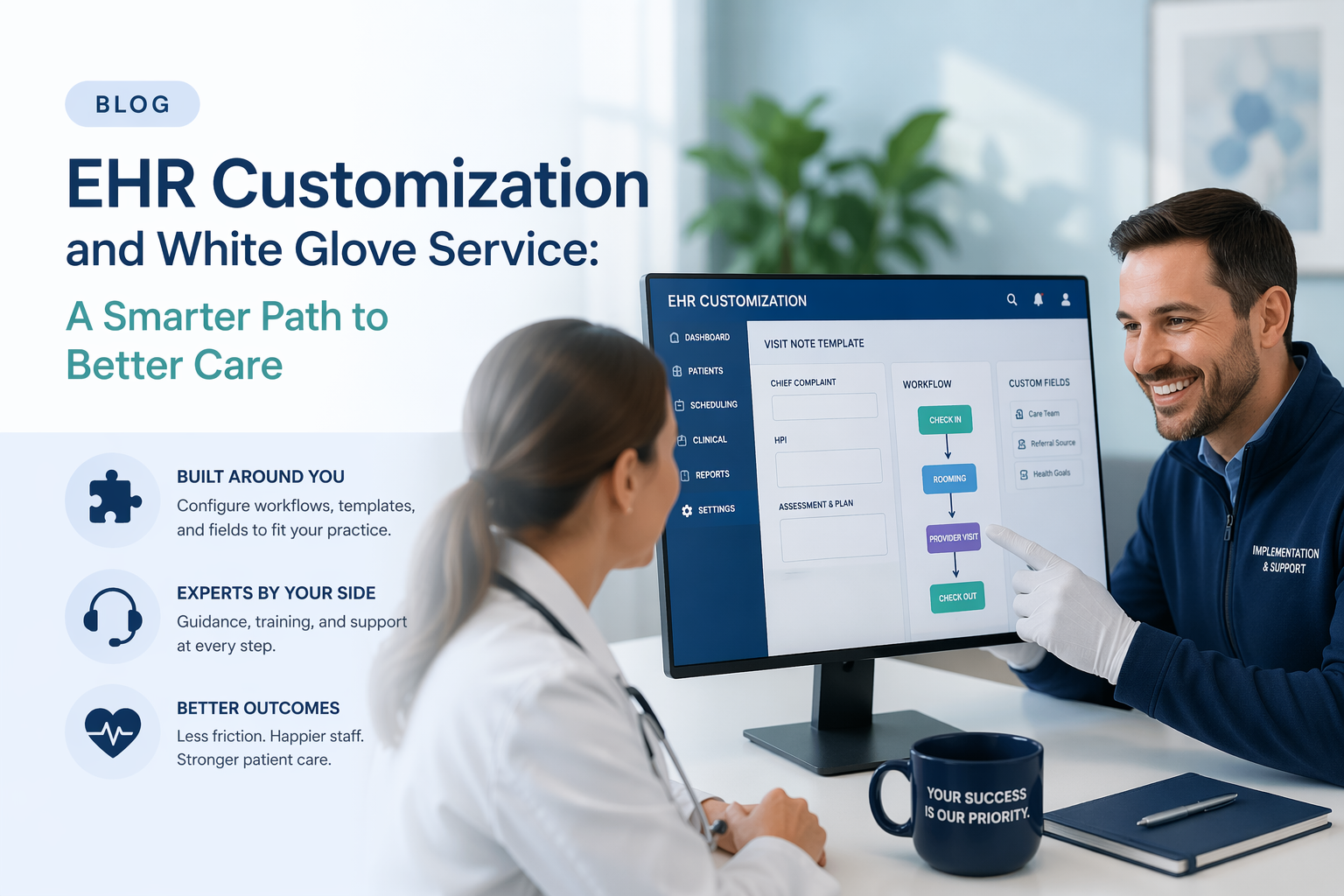
If your EHR forces your staff to adapt to its workflows instead of the other way around, you are leaving time, money, and patient outcomes on the table. Full customization is not a luxury add-on — it is the foundation everything else is built on.
Customization
Build an EHR that mirrors your specialty, not a generic template.
Speed of Development
Features delivered in days or weeks, not months or years.
Pricing FlexibilityPay for what you use. Scale costs as your practice grows.
Modern Workflows
Smarter tools that fit how today’s practices actually operate.
White-Glove Service
A real team that knows your practice by name — always.
In This Article
- Why Customization Is the Most Important Feature in Any EHR
- Waiting Is Not a Strategy: Why Speed of Development Changes Everything
- Stop Paying for Features You’ll Never Use
- Tools That Keep Up With How Today’s Practices Operate
- The Human Difference: What White-Glove Service Actually Means
- How Medi-EHR Compares
- Frequently Asked Questions
Why Customization Is the Most Important Feature in Any EHR
Healthcare is not monolithic. A solo family medicine practice in rural New Jersey operates nothing like a multi-provider behavioral health group in Manhattan, an ambulatory surgery center in Trenton, or a residential treatment facility managing complex care coordination. Yet most enterprise EHR vendors sell every one of those organizations the same rigid software — and charge them enterprise prices to do it.
The result is clinical friction. Staff learn workarounds instead of workflows. Clinicians spend more time fighting the software than treating patients. Administrators build shadow systems in spreadsheets because the EHR cannot handle their specific billing logic or referral process. Every one of those workarounds is a direct cost to your practice — in staff hours, in billing errors, and in frustrated providers who eventually leave.
At Medi-EHR, customization is not a feature tier. It is the architecture. Every module — from the Clinical EHR to Behavioral Health to Workers’ Comp and No-Fault — is designed to be shaped around your practice’s actual workflows, documentation requirements, specialty coding needs, and patient population. When you need something that does not yet exist, Medi-EHR builds it.
What Customization Actually Looks Like in Practice
Custom EHR capabilities span far more than reskinning a template. At Medi-EHR, customization includes:
49%
of physicians cite EHR usability as a top source of burnout
2.6×
more documentation time vs. direct patient care in rigid EHR systems
$125K+
estimated annual cost when a burned-out provider leaves a practice
37%
reduction in documentation time with custom-fit EHR workflows
Waiting Is Not a Strategy: Why Speed of Development Changes Everything
Ask any practice administrator about requesting a custom feature from a major EHR vendor and the answer is almost always the same: submit a feature request, vote on it, and we’ll consider it for a future release. That release might be 18 months away. Or it might never come.
Meanwhile, your practice works around the gap every single day. A billing workflow that does not handle your state’s workers’ comp fee schedule. An intake form that cannot capture the data your referral coordinator actually needs. A patient portal that does not communicate with your scheduling system the way your front desk requires.
These are not hypothetical inconveniences. They represent real hours lost each week, across every staff member who touches the system. Multiply that across a year and the cost is significant — in payroll, in billing errors, and in staff morale.
The Advantage of In-House, Responsive Development
Medi-EHR’s in-house development team shortens the time between “we need this” and “this is live” from months to days or weeks. Because there are no enterprise handoff queues, no offshore pipelines, and no committee approvals required for client-specific work, the team moves at the speed your practice actually needs.
This responsiveness matters most during transitions: when your state updates billing rules (as New York did in 2025 — see our 2025 NY Workers Comp Rule Changes Guide), when new telehealth licensure requirements take effect, or when CMS adjusts documentation standards for a service you provide regularly. A responsive development partner means you are compliant and optimized from day one of any change, not six months later.
Stop Paying for Features You’ll Never Use
Enterprise EHR pricing is notoriously opaque. Practices sign multi-year contracts for a platform license that bundles dozens of modules — most of which go unused — and then pay again for customizations, integrations, add-ons, and support tiers. The total cost of ownership rarely matches what the sales deck promised.
Pricing flexibility is not just about spending less. It is about spending right — investing in the capabilities that generate real returns for your specific practice rather than subsidizing a feature set built for a completely different care model.
A Modular, Transparent Approach
Medi-EHR’s pricing is structured around the way practices actually grow: start with the core platform, add modules as you need them, and scale costs proportionally as your provider count or patient volume increases. Whether you are a solo practitioner or a multi-location group, you are not locked into a tier built for an organization ten times your size.
See a full breakdown on the Plans & Pricing page, or contact the team to discuss a configuration that fits your practice’s current size and growth plans.
Tools That Keep Up With How Today’s Practices Operate
Healthcare administration has changed significantly over the past several years. Telehealth is now a standard care delivery channel. Patients expect to self-schedule online. Billing rules at the state and federal level are updated more frequently than ever. And practices are under growing pressure to document more thoroughly while spending less time doing it.
A modern EHR needs to support all of that — not just the clinical documentation workflows of five years ago. That means tighter scheduling tools, smoother patient intake, integrated communication channels, and software that genuinely helps reduce the administrative burden on clinical staff without adding complexity.
Where Smarter Tools Come In
Medi-EHR includes a range of tools designed to streamline the day-to-day work of running a practice. Automated billing checks flag common claim errors before submission. Scheduling features reduce gaps and no-shows. And the platform includes AI-assisted note creation — a practical option that helps providers complete documentation more efficiently without spending extra time at the keyboard after each appointment. You can see a real-world example of how this works in AI note creation for behavioral health practices.
These tools handle the repetitive, time-consuming parts of documentation and billing so that providers can focus on work that requires their clinical judgment. For more on how these capabilities fit into a broader practice workflow, see How Medi-EHR Is Making AI Work in Healthcare.
Because all of these tools live inside a customized platform, they connect to each other in ways that generic configurations cannot match. A patient who self-schedules online triggers an automated intake form. The completed intake flows into the chart. The provider documents the visit. The claim is generated, scrubbed, and submitted — all without manual re-entry at any step.
The Human Difference: What White-Glove Service Actually Means
Technology is only as good as the support behind it. The healthcare industry is full of practices that purchased excellent software and had a frustrating experience because implementation was rushed, training was generic, and ongoing support was slow or impersonal. The software itself was fine. The relationship was not.
White-glove service is the commitment that the relationship does not end at contract signing. It means your team is supported through every phase — implementation, training, go-live, and the ongoing evolution of your practice’s needs over time.
What White-Glove Looks Like at Medi-EHR
For practices transitioning from a legacy system, the implementation experience often determines whether the new EHR succeeds or gets abandoned within six months. Medi-EHR’s white-glove model is designed to make the transition feel supported rather than disruptive — and to ensure your investment delivers real returns. Read more in Benefits of Switching to Medi-EHR.
How Medi-EHR Compares
Not all EHR vendors offer the same combination of flexibility, speed, and service. Here is how the core differentiators stack up:
| Capability | Legacy Enterprise EHR | Generic SaaS EHR | Medi-EHR |
|---|---|---|---|
| Full workflow customization | Limited / costly | Template only | ✓ Full custom |
| Custom module development | 18–36 month roadmap | Not available | ✓ Days to weeks |
| Custom API / integrations | Available (expensive) | Limited | ✓ Included |
| AI-assisted documentation | Add-on cost | Third-party only | ✓ Available |
| Flexible per-module pricing | Bundled enterprise | Partial | ✓ Full flexibility |
| White-glove onboarding | Premium tier only | Self-serve | ✓ Standard |
| 24/7 US-based support | Enterprise contracts only | Business hours | ✓ All clients |
| Specialty-specific workflows | Partial (select specialties) | Generic only | ✓ All specialties |
See What a Custom EHR Looks Like for Your Practice
Medi-EHR builds around your workflows — not the other way around.
Schedule a personalized demo and see the difference customization makes.
Frequently Asked Questions
EHR customization means tailoring your electronic health record software — its workflows, templates, modules, portals, and integrations — to match how your specific practice operates, rather than forcing your staff to adapt to rigid, generic software. Every practice has unique specialty needs, billing structures, patient populations, and documentation requirements. A customized EHR reduces clicks, eliminates redundant steps, and helps clinicians spend more time on patient care. Learn more: What to Look for in an EHR/EMR and Practice Management Software.
At Medi-EHR, custom modules and features can often be scoped, developed, and deployed in days to weeks rather than the months or years typical of large EHR vendors. Our in-house development team works directly with practice administrators to deliver exactly what is needed, without bureaucratic handoffs or public roadmap queues.
Not necessarily. Medi-EHR offers transparent, flexible pricing that scales with your practice. Rather than paying for a bundled enterprise license full of features you never use, you pay for what your practice actually needs. Custom modules, APIs, and data exports are each priced individually, so practices of any size can build a cost-effective configuration.
Yes. Medi-EHR includes AI-assisted note creation and other automated workflow tools built directly into the platform — not as a third-party add-on. These features help reduce the documentation burden for clinical staff without requiring them to learn a separate application. See a practical example: AI note creation in behavioral health.
White-glove service means a dedicated, hands-on support relationship — not a chatbot or a ticket queue. It includes personalized onboarding, custom training built around your specific workflows, direct access to support staff who know your practice, proactive check-ins, and responsive help when issues arise. For Medi-EHR clients, this level of service is standard, not a premium tier. Learn about our support model.
Yes. Medi-EHR offers custom API development, custom modules, vendor portals, custom exports, and direct integrations with labs, radiology systems, and HIEs.
Yes. Medi-EHR is ONC Certified Health IT, certified by an ONC-Authorized Certification Body in accordance with applicable criteria adopted by the Secretary of Health and Human Services. View our ONC Certification details and transparency disclosures.